

A business model is simply the way a company makes money while delivering value to its customers. In other words, it explains how a business creates, delivers, and earns from its products or services. Every successful company, whether small or global, follows a specific model that supports how it operates and grows.
In today’s digital economy, understanding business models is more important than ever. With so many online platforms, startups, and digital services emerging, people are no longer limited to traditional ways of doing business. From e commerce stores to freelance platforms and streaming services, each one works on a different system of generating income and serving users.
For entrepreneurs, students, and business owners, learning how business models work can make decision making much easier. It helps in identifying opportunities, avoiding mistakes, and choosing the right strategy for growth. Whether someone is starting a new venture or studying how successful companies operate, understanding the basics of business models provides a strong foundation for smarter business decisions.
What Is A Business Model
A business model is the framework that explains how a company operates and earns revenue while delivering value to its customers. It describes what the business offers, who it serves, and how it sustains itself financially over time. In simple terms, it answers the question of how a business makes money.
Every company, whether traditional or digital, follows a specific structure to stay profitable and competitive. Some businesses sell products directly to customers, while others provide services to companies or act as platforms connecting different users. This structure is what defines the business model.
Understanding the business model types is important because it helps you see how successful companies are built and why certain strategies work better in specific markets. For example, some models focus on selling products in large volumes, while others rely on subscriptions or commissions. Each approach has its own advantages depending on the target audience and industry.
In today’s fast changing digital world, business models are also evolving quickly. Online platforms, apps, and global marketplaces have introduced new ways of earning money, making it essential for anyone interested in business to understand how these systems function.
The 4 Types Of Business Models
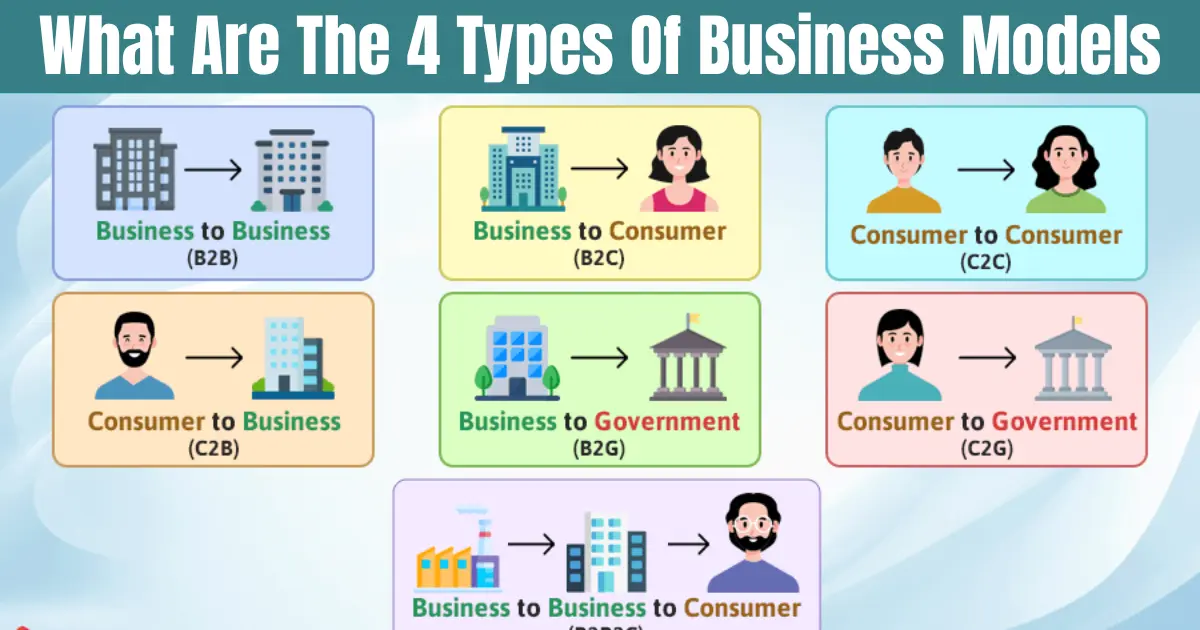
Understanding what are the 4 types of business models helps you see how most companies in the world operate and generate revenue. These four models form the foundation of both traditional and digital businesses, and almost every successful company fits into one of them.
Below is a simple breakdown of each type with clear explanations and real world examples.
1 Business To Business Model
The Business To Business model, often called B2B, is when one company sells products or services directly to another company instead of individual customers. These businesses usually focus on providing tools, software, raw materials, or professional services that help other businesses operate more efficiently.
In this model, transactions are often larger in value and built on long term relationships. Companies in this space focus heavily on performance, reliability, and scalability.
Examples include enterprise software providers, marketing agencies, and industrial suppliers. Businesses like Salesforce and Microsoft are strong examples of B2B companies that provide solutions used by other organizations worldwide.
2 Business To Consumer Model
The Business To Consumer model, also known as B2C, is when a company sells products or services directly to individual customers. This is the most common business model that people interact with in daily life.
It includes online shopping platforms, retail stores, streaming services, and food delivery apps. The main goal in this model is to attract as many individual customers as possible and provide a smooth buying experience.
Companies like Amazon and Netflix are popular examples of B2C businesses that serve millions of users globally through direct services and products.
3 Consumer To Consumer Model
The Consumer To Consumer model, or C2C, happens when individuals sell products or services directly to other individuals, usually through an online platform that acts as a middleman.
These platforms make it easy for people to buy, sell, rent, or trade items without needing a traditional business structure. It has become very popular due to the rise of the sharing economy and online marketplaces.
Well known examples include eBay and Airbnb, where users interact directly with each other to complete transactions.
4 Consumer To Business Model
The Consumer To Business model, or C2B, is when individuals provide products or services to companies. This is the reverse of the traditional business to consumer model.
It is very common in the digital world, especially with freelancers, influencers, and content creators who offer their skills or audience reach to businesses. Companies benefit from individual creativity, expertise, or influence.
Platforms like Upwork and Fiverr are leading examples where individuals offer services directly to businesses around the world.
Comparison Of The 4 Types Of Business Models
Now that we understand what are the 4 types of business models, it becomes easier to compare how each one works and why businesses choose different approaches depending on their goals and target audience.
Each model serves a different purpose. Some focus on selling to companies, while others target individual customers or even enable people to trade directly with each other. The way revenue is generated, the scale of operations, and the customer relationship all vary across these models.
In the Business To Business model, companies focus on long term contracts, bulk deals, and professional solutions. In contrast, the Business To Consumer model is more focused on high volume sales and direct customer experience. Consumer To Consumer models rely on platforms that connect individuals, making transactions more flexible and community driven. Meanwhile, the Consumer To Business model is built around individuals offering value such as skills, content, or influence to companies.
Another key difference lies in how trust and relationships are built. B2B models depend heavily on reliability and performance, while B2C focuses more on branding and customer satisfaction. C2C relies on platform trust and user ratings, and C2B depends on personal reputation and individual expertise.
By understanding these differences, it becomes much easier to identify which model a business is using and how it is designed to generate income in a competitive market.
Why Business Models Matter
Business models are not just theory, they are the foundation of how any successful company operates and grows. Understanding them helps you see the bigger picture of how money flows in a business and how value is created for customers.
For entrepreneurs, knowing different business model types is extremely important because it helps in choosing the right direction before starting a venture. The wrong model can make even a good idea fail, while the right one can turn a simple idea into a scalable business.
For students and learners, understanding business models builds strong business thinking skills. It makes it easier to analyze companies, understand case studies, and see how real world businesses succeed or struggle in different markets.
For business owners, it helps in improving strategy and adapting to market changes. For example, many companies today are shifting from traditional sales to subscription based or platform based models because customer behavior is changing in the digital economy.
In short, business models act as a roadmap. They guide how a business earns, grows, and stays competitive in an environment where innovation and customer expectations are constantly evolving.
Real World Examples In Daily Life
Business models are all around us, even if we do not always notice them. Every time you shop online, watch a movie, order food, or use an app, you are interacting with a specific type of business model in action.
For example, when you buy products from an online store, you are experiencing a Business To Consumer model where companies sell directly to you as an individual customer. When you book a stay through a rental platform, you are often seeing a Consumer To Consumer model, where one person provides a service or property to another through a trusted platform.
If you are working as a freelancer or selling digital services online, you are participating in a Consumer To Business model, where your skills or services are offered to companies that need them. On the other hand, when large organizations use software tools or enterprise services, they are part of a Business To Business model.
Even entertainment platforms, delivery apps, and social media services are built on these models. They combine technology and business strategy to make everyday life more convenient while generating revenue in different ways such as subscriptions, commissions, or advertising.
By observing these real world examples, it becomes much easier to understand how deeply business models are integrated into our daily activities and how they shape the modern digital economy.
Expert Insight EEAT Optimization
Successful business models are not chosen randomly. They are built through experience, market understanding, and continuous adaptation to customer needs. Companies that perform well over time usually focus on solving real problems while selecting a model that matches both their product and their audience behavior.
From an industry perspective, one key factor behind strong business performance is alignment. For example, companies that offer complex software solutions often succeed with a Business To Business model because it allows long term contracts and deeper customer relationships. On the other hand, consumer focused brands rely heavily on Business To Consumer models where branding, trust, and user experience drive sales.
Experience also shows that many modern companies do not rely on just one model. Instead, they combine multiple approaches. For instance, a platform may serve consumers directly while also offering tools for businesses, creating a hybrid structure that increases revenue streams and market reach.
Expert analysis in digital business trends also highlights that adaptability is critical. As customer expectations change, companies often shift from traditional selling methods to subscription based services or platform driven ecosystems. This flexibility is what keeps businesses competitive in fast moving digital markets.
In terms of trust and authority, businesses that consistently deliver value, maintain transparency, and build strong customer relationships tend to outperform competitors. This is a core principle behind sustainable growth in any business model.
Conclusion
Understanding what are the 4 types of business models gives you a clear picture of how businesses actually operate in the real world. Whether it is a company selling to other businesses, directly to customers, or platforms connecting individuals, each model has its own structure for creating value and generating income.
The Business To Business, Business To Consumer, Consumer To Consumer, and Consumer To Business models form the foundation of both traditional and modern digital economies. Once you understand these models, it becomes easier to analyze companies, start your own venture, or make smarter business decisions.
In today’s fast changing digital world, knowing how these systems work is no longer optional. It is a basic skill for anyone who wants to succeed in business, entrepreneurship, or even digital careers.
